Meet the Animals of the Adirondack Carousel
Every Animal Has a Name – and a Story to Tell
Meet the Wildlife
That Calls Our Carousel Home
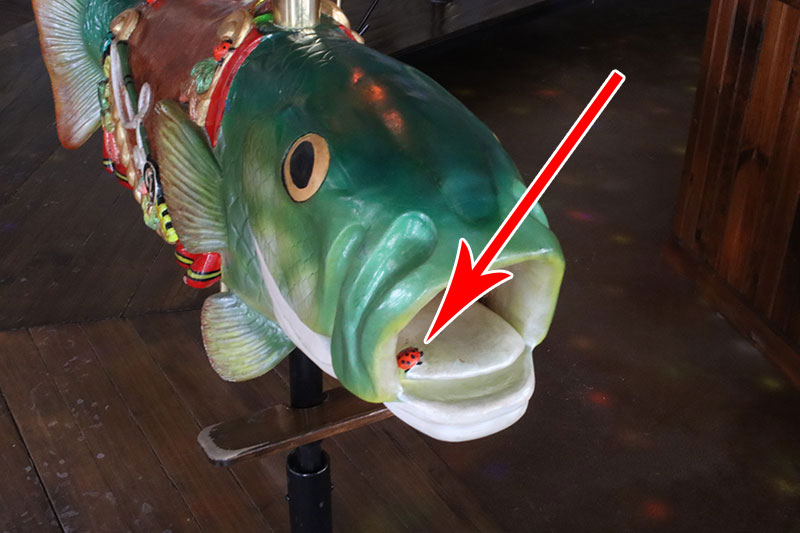
Every figure on the Adirondack Carousel is a hand-carved tribute to the wildlife of the Adirondack Park, shaped and painted by skilled artists and brought to life by the community that built it. Each animal carries two stories: the tale of the real creature that roams our woods and waters, and the tale of the carving itself – who carved it, who sponsored it, and the name local schoolchildren gave it. Below, meet all twenty figures that ride (and one that doesn‘t go up and down at all). Look closely and you may spot the ladybug tucked onto every carving – New York State ‘s official insect and the object of many a happy hunt.
Want to take a story home? Each animal below links to a printable information sheet you can download and read at your leisure.
Think you know your Adirondack animals? After you’ve met the whole crew, take our Carousel Animal Quiz and find out how much you remember. Perfect for curious kids and the grown-ups who ride along!
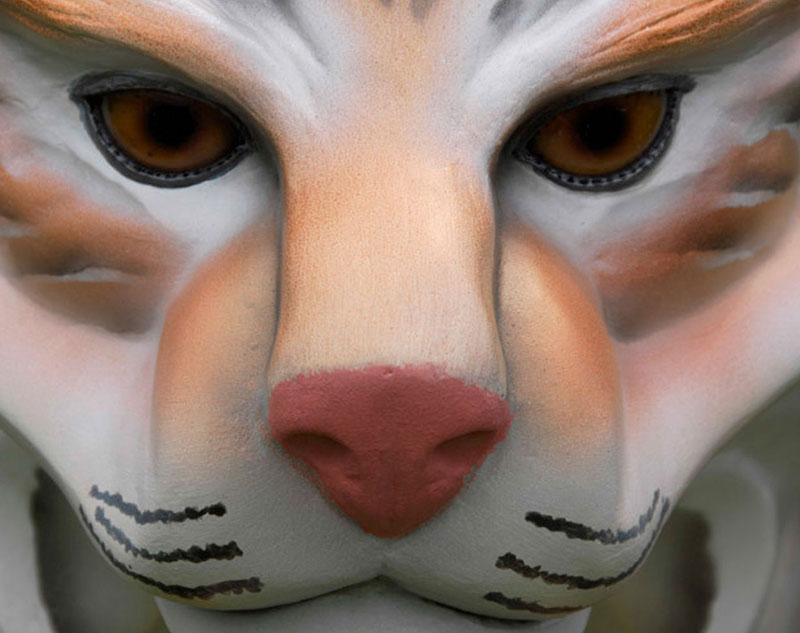
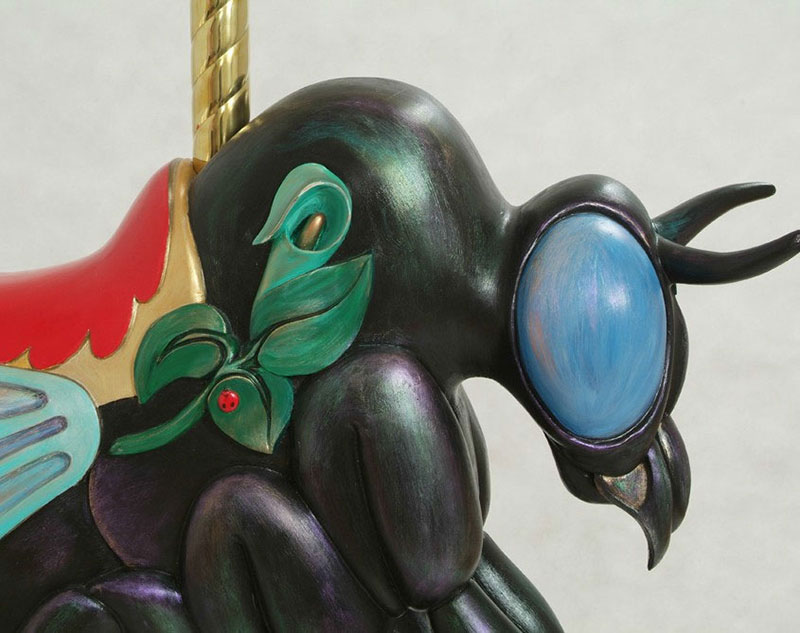
Bug Eye the Black Fly
Carvers: Walt Reuss & Rich Kraft (Mansfield, OH & Saranac Lake, NY) | Sponsors: Marge & Ted Glowa
If you spend enough time in the Adirondack woods and waters, you will find all of the animals that ride the carousel – except for Bug Eye. He’ll find you! Black flies can arrive earlier and linger later, but it’s generally between Mother’s Day and Father’s Day that Bug Eye comes looking for you. Everyone in the Adirondacks has a “sure-fire” defense – ointments, salves, hats, and sprays of every kind – but you will never regret keeping an old-fashioned head net in your pack.
The black fly is also known as a buffalo gnat, a turkey gnat, and, for some reason, a white socks. These aquatic insects prefer clean, fast-running water; their larvae are eaten by fish and other aquatic animals, while the adults are prey for birds. Black flies are most active a few hours after sunrise and a few hours before sunset. Their bites can cause swelling, bleeding, pain, and itching – though the male flies are not attracted to humans and cannot bite at all.
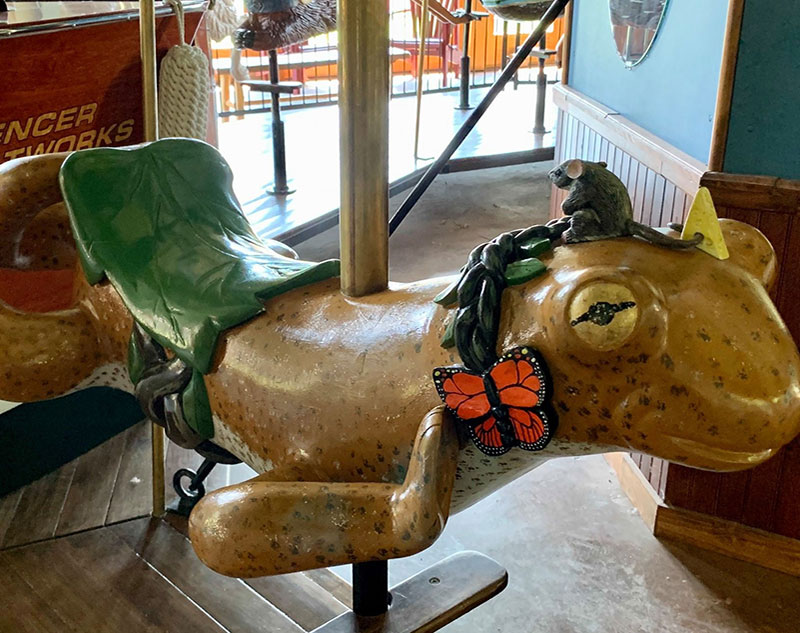
Wiggly the Salamander
Carvers: Al Becker, Wayne Miles, Russell Musgrave, Sonny Schiller, Keith Hargrove, and James Barker | Sponsor: Adworkshop
Wiggly travels around the carousel with his own little mouse friend – who travels with his own block of Swiss cheese! All of the carousel animals were named by local schoolchildren, which is exactly why we have a salamander named Wiggly (and a doe named John).
Salamanders are amphibians and live in or near water. Despite how different they look, they are closely related to frogs. Baby salamanders are born with gills and fins that shrink as they grow lungs and legs, changing from a water animal into a land animal. They are nocturnal and very shy, and their skin is extremely sensitive – so if you see one, look but don’t touch.
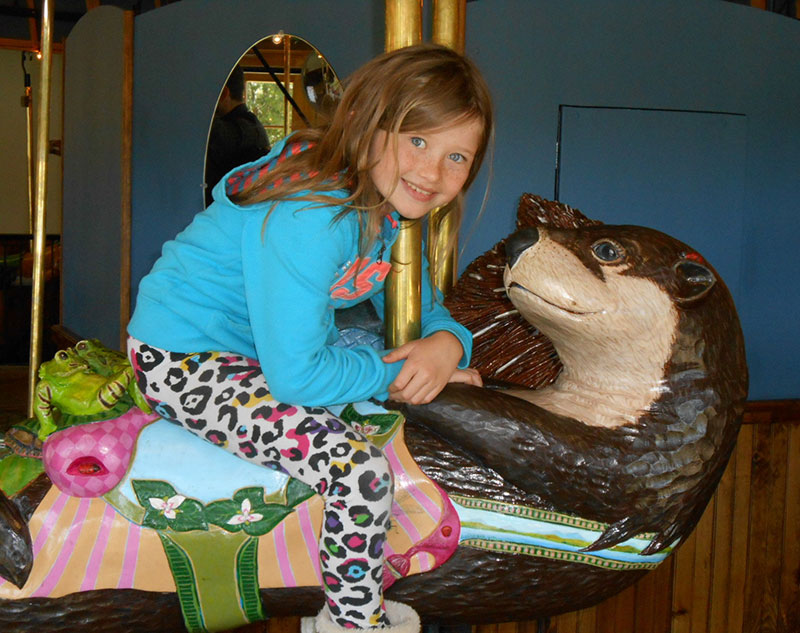
Oliver the North American River Otter
Carvers: Karen Loffler, Carl Borst, and Rich Kraft (Saranac Lake, NY) | Sponsor: The Wild Center
Oliver, what a sweetheart! He’s the only animal that lets you ride on his belly and looks back at you so you can rub his nose – he loves that. Oliver is a wonderful choice for your little one’s first carousel ride, and rarely does the carousel go around without someone aboard him.
The river otter, a member of the weasel family, is a common resident throughout the Adirondack Park. Naturally curious and wildly energetic, otters don’t spend their time building dens – they prefer to occupy the deserted dens of other animals, which leaves them free to do what they love most: play!
Flames the Red Fox
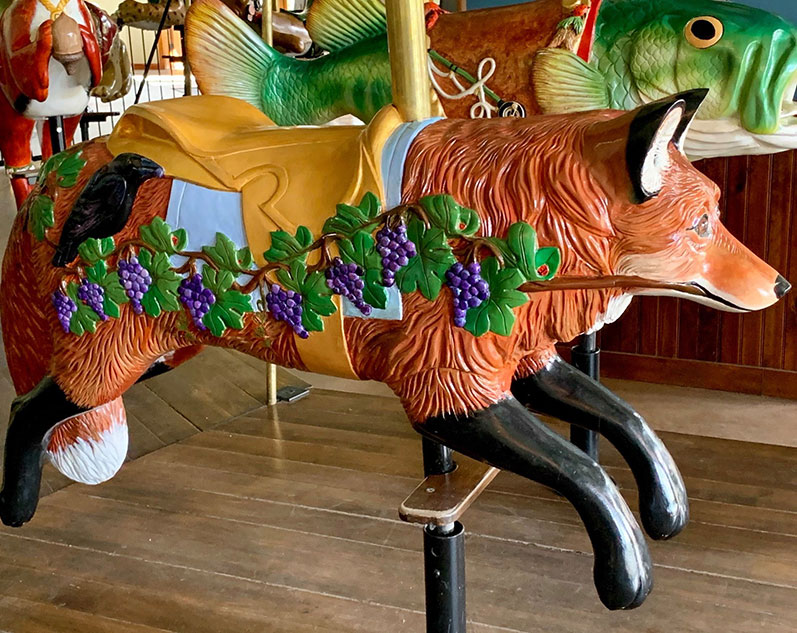
Carver: Alice Porter (Ogden, Iowa) | Sponsor: Marie White
What a lucky day for Flames and his feathered friend – they’ve found a vine of fox grapes! Fox grapes are the most common wild grape in the Adirondacks; they look delicious, but they make much better vinegar than they do wine. And if you’re on a ladybug hunt, Flames will be your biggest challenge.
The red fox is the largest of the fox family. These carnivores will eat any small creature they can catch, and they must stay careful themselves, because coyotes and eagles would happily make a meal of them. Though the fox is a canine, its behavior is more catlike than doglike: it checks its surroundings by standing on its hind legs and sniffing the air, and it can hear a watch ticking or a mouse squeaking from 120 feet away. The red fox is one of the cutest animals in our woods, and sometimes it looks like it’s smiling at you. It isn’t! It’s either afraid of you or wondering what you taste like – either way, give it plenty of space.
Soarin the American Bald Eagle
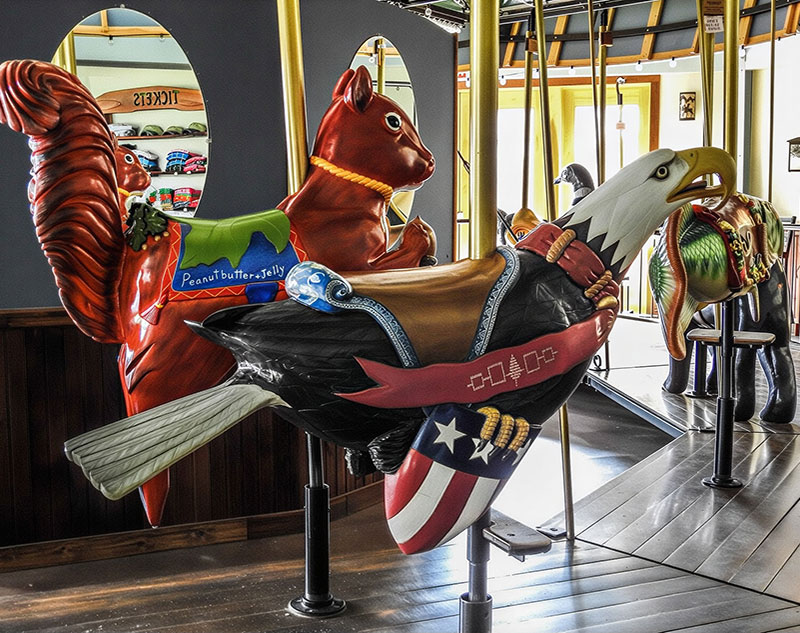
Carver: Carl Borst (Rotterdam, NY) | Painter: Sandra Hildreth (Saranac Lake, NY) | Sponsor: Anonymous
The bald eagle has been the national emblem of the United States since 1782, and a spiritual symbol for native people for far longer than that. It is often called the American bald eagle because it is the only eagle found solely on the North American continent. Soarin carries a Stars-and-Stripes shield and wears a sash proudly emblazoned with the symbol of the Iroquois Confederacy – the original Five Nations (Seneca, Cayuga, Onondaga, Oneida, and Mohawk) on whose ancestral land the carousel now stands. Benjamin Franklin, a coauthor of the Constitution, believed a government like the Iroquois Confederacy could be a model for the English colonies as they built the new United States.
The bald eagle has a heavy body, a large head, and a long, hooked bill. The female is 25% larger than the male, with a wingspan that can reach eight feet. In flight, the eagle holds its broad wings flat like a board. Eagles build their nests in trees or on cliffsides near water, adding to them each season until they can grow up to ten feet across; they mate for life and return to the same nest year after year. With both monocular and binocular vision, an eagle can use each eye individually or together, see four or five times farther than the average person, and spot prey the size of a rabbit from three miles away.
Twitter the Hermit Thrush
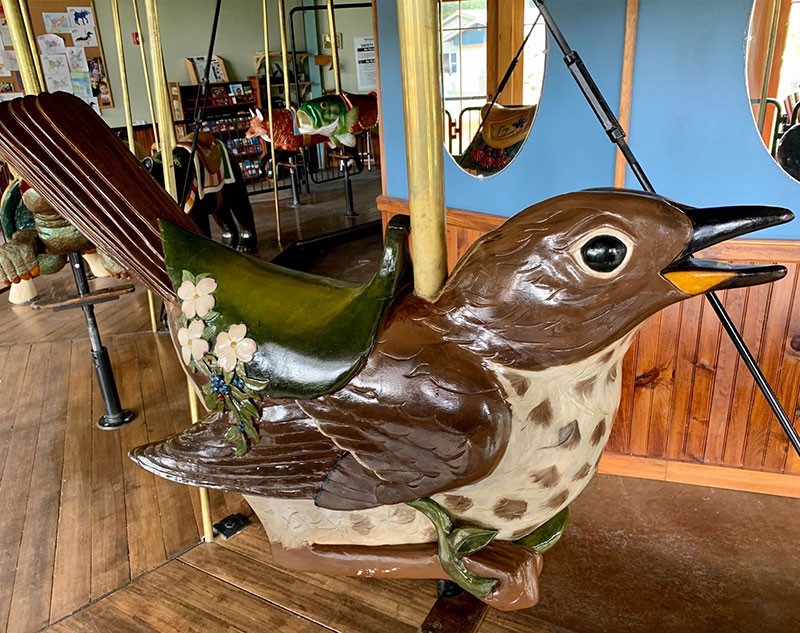
Carver: Tracy Kochanski (Westfield, MA) | Sponsor: Carolyn Eisenmenger
Take a good look at Twitter so you’ll remember what she looks like – in the wild she is so shy that you may hear her lovely song but never see her, for she lives hidden in the woods just like a real hermit. Twitter’s carver recalls a childhood memory of riding a carousel: “I closed my eyes. It felt like I was flying.” The western section of the Adirondack Park is the ancestral land of the Oneida Nation, part of the Haudenosaunee Confederacy; Oneida parents tell their children the legend of the hermit thrush to teach the importance of honesty – and that ill-gotten gains always come with an unforeseen cost.
The hermit thrush is a medium-sized bird with grey-brown feathers on its head and wings, a white underside dappled with dark red-brown spots, and a rust-colored tail. It has a chunky body, pinkish legs, large eyes, and a slender beak. Hardier than its relatives, it tolerates cold better than other thrushes – it is the last to leave the Adirondacks in the fall and the first to return in the spring. It flicks its tail as it prepares to fly and wiggles the grass with its feet to shake loose an insect or two. Its normal call is hard to describe, something like a mewing kitten if it were chirping, and it sings a low-pitched note to signal attacks or when escaping danger.
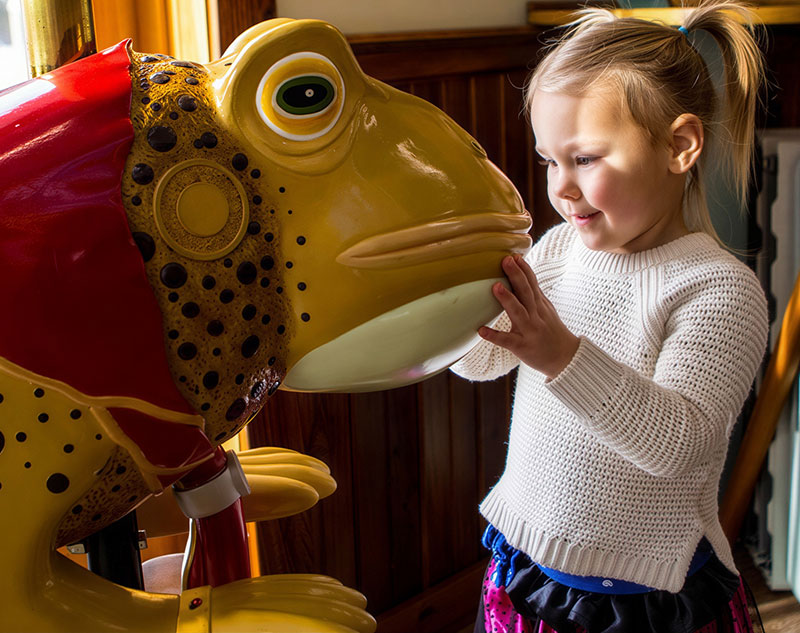
Buck the Toad
Carver: Clifton “Jack” Barrette (Plattsburgh, NY) | Sponsors: Northern Insurance Agency, Inc. & The Giltz & McCullough Families
Want to know a secret? Promise not to tell… Buck is a 100-year time capsule! Who will open it? We don’t know. What’s inside? Several items – the carver tucked away present-day (2011) memorabilia to be discovered in a century. The only item we know about is the carver’s business card, which he left inside “in case they need someone to make repairs at that time.”
Toads and frogs are easy to tell apart: toads have brown, bumpy, dry skin and frogs have smooth green skin; toads have short legs and crawl slowly while frogs have powerful legs and jump quickly; toads live on land while frogs live in or near water. Both eat insects like flies and mosquitos, using their long, sticky tongues to catch them, and both have four-fingered hands and five-toed feet. Frogs and toads are known as “indicator species” – scientists study them because the health of the frogs and toads reflects the health of the overall environment.
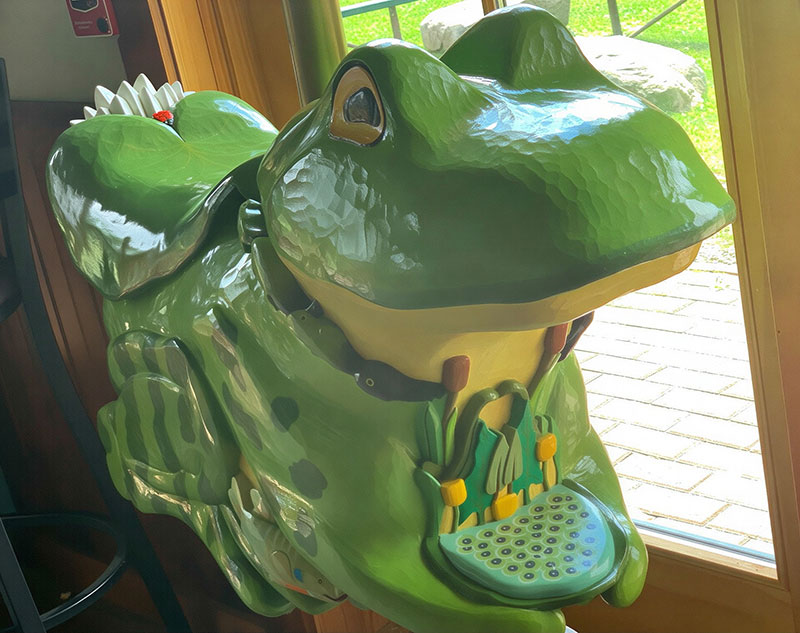
Lilly the Frog
Carver: Myrl Phelps | Sponsor: Steve Schnibbe
What is Lilly holding? That is an egg mass – and if you follow Lilly’s “necklace,” you’ll see the frog’s entire life cycle. It begins with the egg, then moves through tadpole, tadpole with legs, froglet, and finally – like Lilly – an adult frog. This exact process of metamorphosis is completely unique to amphibians.
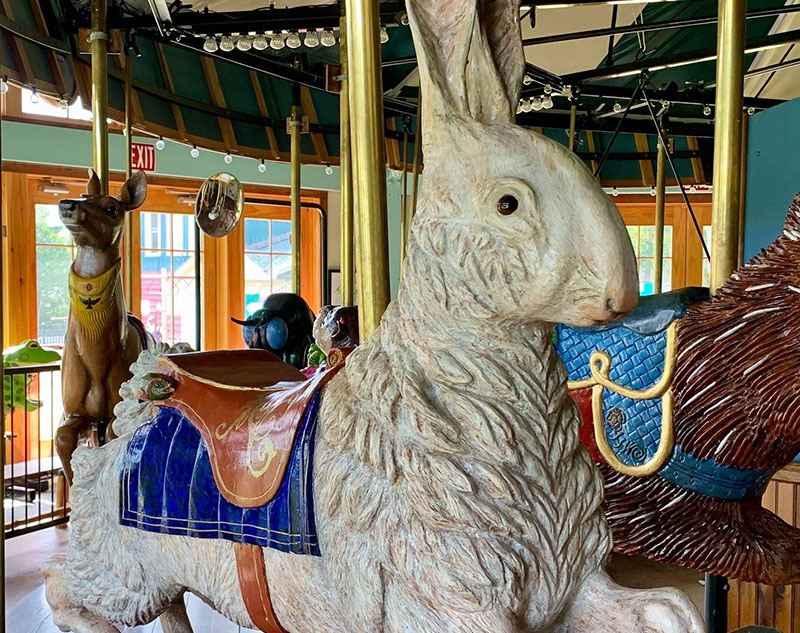
Harry the Snowshoe Hare
Carver: Ed Hepp (Saratoga Springs, NY) | Sponsors: Stewart & Charlotte Lyon
There are some things you’ll hear over and over again at the carousel. One of them is… “The Bunny! The Bunny! I wanna ride the Bunny!” And if it’s anywhere near Easter, you’ll probably have to wait your turn for a ride with Harry. Many families take their holiday photos at the carousel: Harry is popular at Easter, Flames the Fox for bridal photos, Soarin the Eagle for the Fourth of July, and of course John Deer stays busy in December.
Depending on the season, the snowshoe hare can be brown, mottled, or white. Because they are active year-round, this changing color is a great advantage, keeping them hidden from predators. If you see one, it will likely be around dawn or dusk, when they are most active, feeding on plants, grasses, flowers, and the fresh growth of trees and bushes. Snowshoe hares are sometimes called snowshoe rabbits, but they are not rabbits – they differ from birth. Rabbits are born blind and helpless, while hares are born fully furred and ready to run. Hares have bigger ears and develop much larger back legs and feet, making them faster – and those large feet let the snowshoe hare stay on top of fresh snow instead of sinking into it.
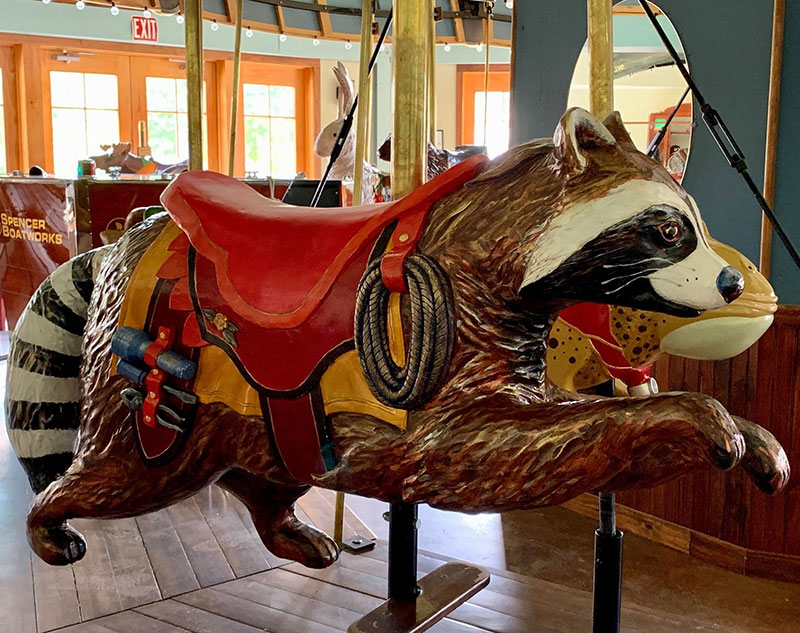
Ranger the Raccoon
Carver: Carl Borst (Rotterdam, NY) | Sponsor: Stewart’s Shops
When things need to be fixed at the carousel, it’s Ranger to the rescue. Ranger is the carousel mechanic’s best friend, because he has all the tools! The carousel requires regular maintenance – bearing grease, chain lubrication, and constant checking that all fasteners are tight and in good condition – and safety checks are performed every single day.
Raccoons are native to all of North America and can roam up to ten miles in a day or night in search of food, adapting well to every kind of climate and terrain. These mammals are remarkably smart – they can figure things out nearly as well as monkeys – and their dexterous claws let them handle small objects methodically, easily untying shoelaces or helping themselves to a misplaced wallet. With a keen sense of smell and excellent eyesight, raccoons have been known to use over 200 distinct sounds to communicate. They are shy but can appear friendly; even so, they do not make good pets, and in most states it is illegal to domesticate them.
John the White-tailed Deer
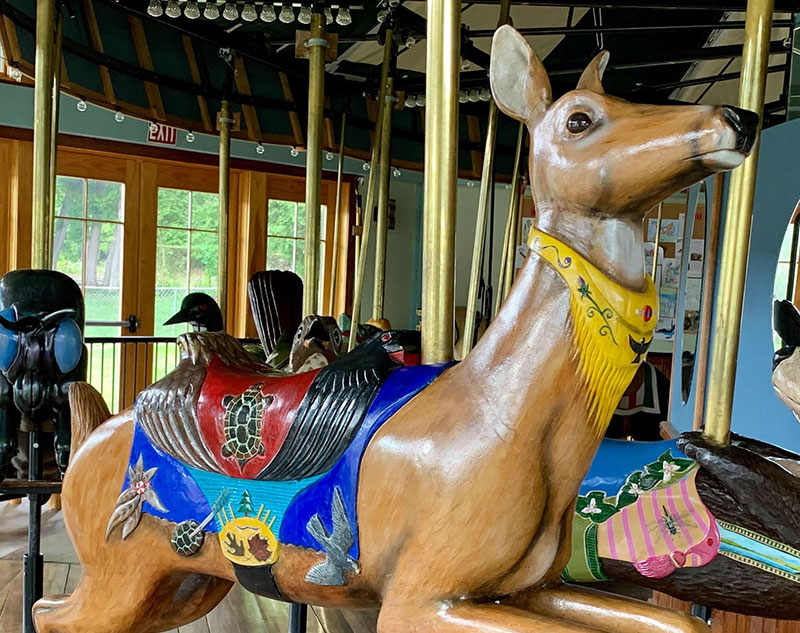
Carver: William Underwood (Endicott, NY) | Sponsor: Edie Crawford
John Deer (a doe) is one of the carousel animals that is life-size. John’s adornments represent the clans, symbolism, and teachings of the Native American Abenaki Nation. Like the Abenaki did before us, current residents of the Adirondack Park strive to maintain a reciprocal relationship with the land and the water. John was named by local schoolchildren – which is how a doe came to be named John.
White-tailed deer are most active at dawn and dusk. They have good eyesight, excellent hearing, and can run up to 30 mph. Considered the athletes of the forest, in a single bound they can leap forward up to 30 feet and as high as 8 feet. They are not aggressive and prefer flight to fight.
Beethoven the Moose
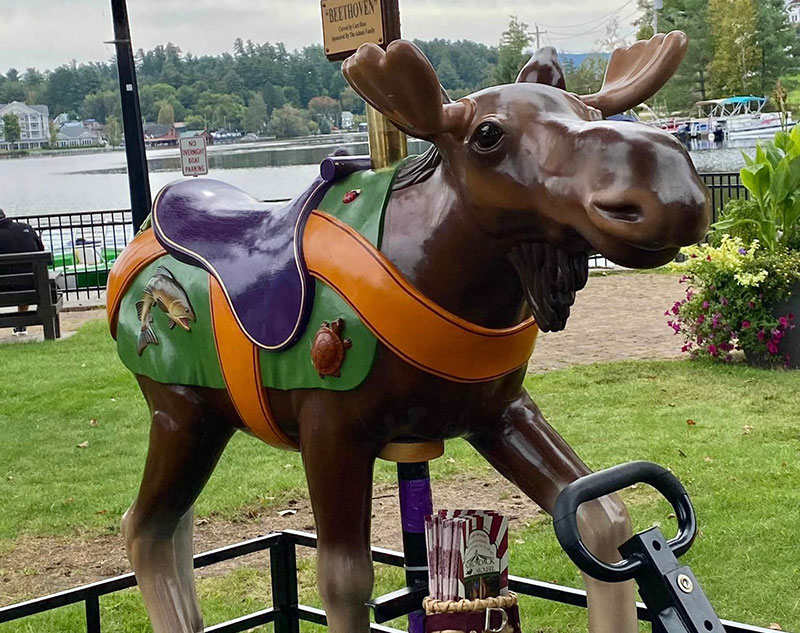
Carver: Carl Dion | Sponsor: Mr. & Mrs. Nicholas Adams
In the winter, Beethoven waits for you inside where it’s warm and dry. In the warmer months you’ll find him hanging around outside the front door – but sometimes he’s nowhere to be found! Beethoven likes to get out and see his town. Sometimes he wanders to the farmer’s market or the Mercantile, and sometimes he seems to have no destination at all, just wandering around town handing out lollipops.
Moose are solitary animals with long bodies, long legs, and thick, insulating fur. They eat vegetation, twigs, branches, and dead wood. A moose can run at 35 mph and swim steadily for hours. They have poor eyesight but excellent senses of hearing and smell.
Tommy the Brook Trout
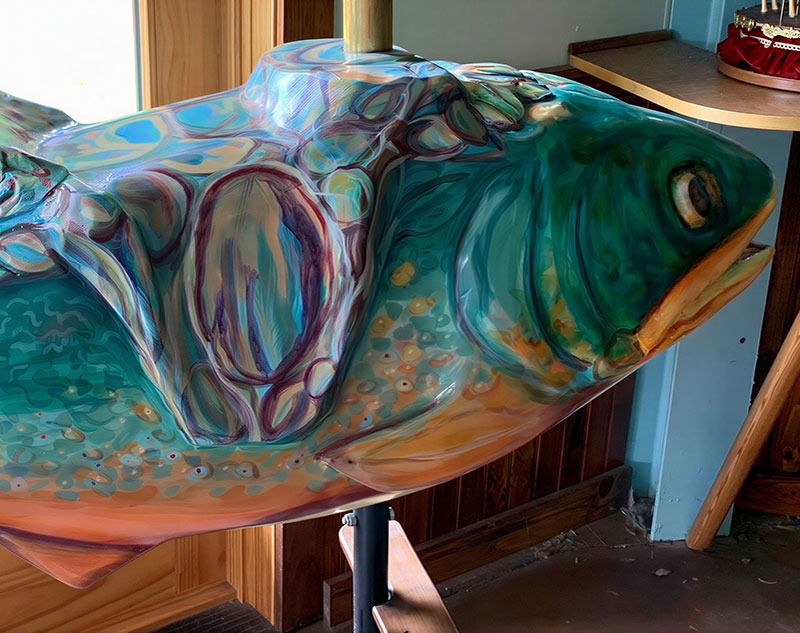
Carver: Carol Marie Vossler | Painters: Nancy Brossard, Carol Marie Vossler, John LaFalce | Sponsor: Anonymous
Tommy is a big boy – he is the heaviest of all the carvings! As one Adirondack fisherman put it: “If you have ever caught one, they are a thrill and an absolute gem to the eye. In my experience, no other fish that you try to catch feels like you are hunting with a fishing rod and line. They are tricky, and thus a true challenge. It sure is a splendid feeling catching one.”
Brook trout are not trout at all – they are “trout-like” and actually a char. These fish are specialized to live in cold climates, inhabiting large lakes and tiny mountain streams alike, but they require cold, clean, highly oxygenated water and prefer temperatures between 34 and 72°F.
Bubbles the Great Blue Heron
Carvers: Phil Burke & Leo Lambert, The Woburn Guild of Carvers (Woburn, MA) | Sponsor: Nancy Wilder Cummings
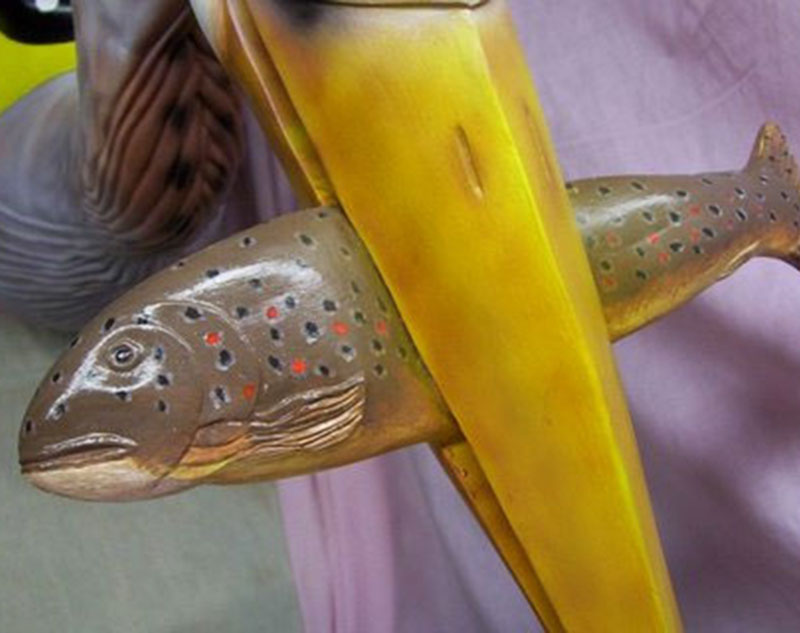
Bubbles has the biggest ladybug of all, and it’s hiding in plain sight – did you find it? Bubbles even caught a brookie! If you spend any of your Adirondack time quietly paddling a canoe or kayak, sooner or later you’ll come across a great blue heron.
The great blue heron is a wading bird found mainly in North and Central America, with a long, narrow body, grayish feathers, black eyebrows, and a long bill. Its neck is long and its eyes are yellow or red. In some places these herons stay for the winter, but not in the Adirondacks – there isn’t enough unfrozen water here for them to catch food. In spring, the males return first, pick a nesting site, and wait for the females to arrive. Herons nest in groups close to their food source, reusing and enlarging their nests each year until they reach three to four feet across. A group of heron nests is called a heronry or a rookery. Native Americans consider the heron a symbol of peace and good luck – and when you see one, you’ll think so too.
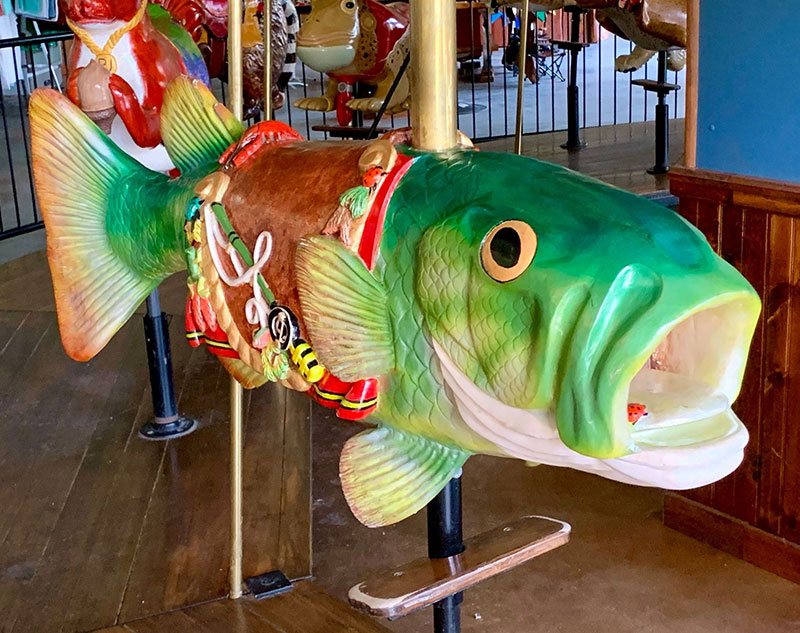
Flipper the Largemouth Bass
Carvers: The Fanning Garage Grinders (Lake Pleasant, NY) | Sponsor: Louis Ruben
The carousel animals were carved from American basswood – a soft, light wood with a straight, fine grain in which knots and other defects are uncommon. Flipper was carved by Master Carver Eileen Fanning and her daughters Pamela and Patricia, both award-winning carvers in their own right. When the trio heard about the Adirondack Carousel project, they were thrilled at the prospect of having their work immortalized in such a worthwhile community project. The bass was one of the first carousel animals to be completed.
The largemouth bass is a freshwater fish and the most popular game fish in North America. They are exciting to catch because they are aggressive and put up a good fight. Bass prefer water temperatures around 60°F and eat aquatic plants, insects, frogs, and smaller fish. Except for humans, bass are the top predator in the aquatic ecosystem, though they themselves can fall prey to larger fish, waterfowl, and water snakes. Largemouth bass are fast swimmers, and they only get faster as they grow: at 20 inches they can swim at 10 mph with 20 mph bursts, darting and changing direction with ease.
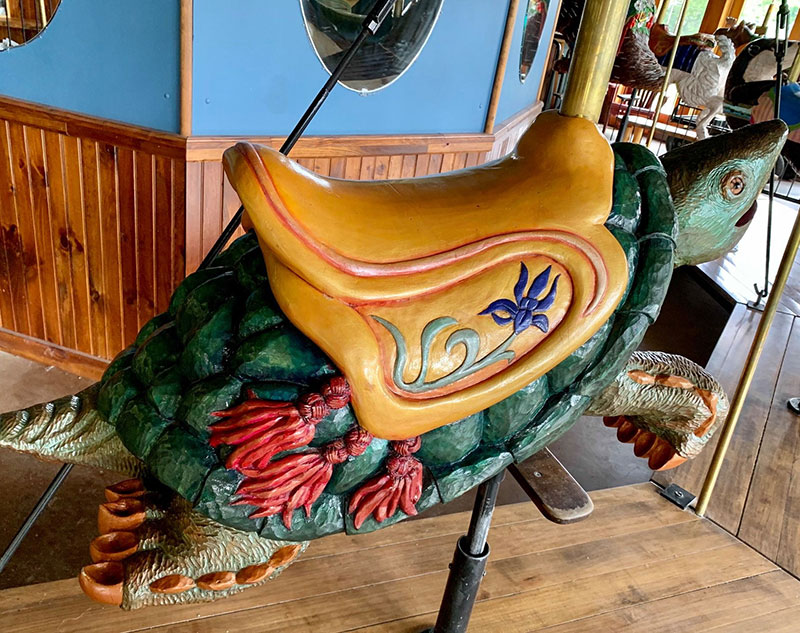
Shelly the Common Snapping Turtle
Carvers: Pony Keepers Carvers and Painters (Missoula, Montana) | Sponsor: The Urell Family
Shelly is one of the most detailed carvings on the carousel – look her over closely, front to back and top to bottom; she is spectacular. The shell (carapace) of most common snapping turtles grows to around 12 inches long, but some wild snappers measure twice that and weigh over 75 pounds. Shelly is one of the carvings that could be close to actual size, though the largest snapping turtle in captivity is considerably larger than she is. And because ladybugs can land on water and paddle around – holding their breath underwater, but not for very long – Shelly’s ladybug has her very own snorkel. Can you think of a good name for Shelly’s ladybug? We’d love to hear it!
The snapping turtle is New York State’s official state reptile and the most commonly observed turtle in the Adirondack Park. They spend much of their lives in aquatic habitats – marshes, ponds, large lakes, reservoirs, and rivers – and although found in nearly every kind of freshwater, they prefer slow-moving water and feel most at home in shallow, marshy swamps with a soft mud bottom. They overwinter on the muddy bottoms of water bodies, usually not far from shore. In the water, a snapping turtle will usually dive or swim away from a human; on land, it can be very aggressive. How hard do they bite? Not that hard, actually – a human can generate five times more biting force than a snapping turtle. But that snap is no joke: the combination of biting force, the speed of the snap, and a very sharp hooked jaw has resulted in many lost fingers.
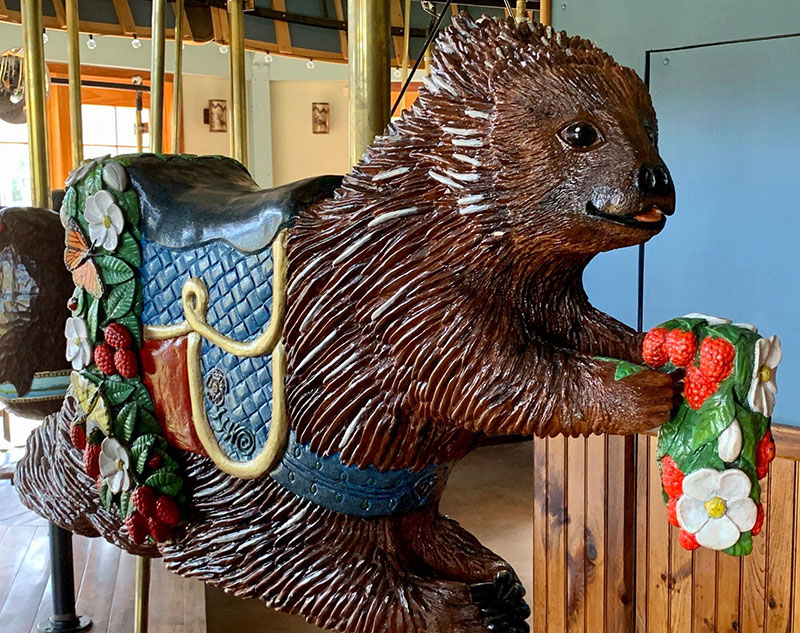
Spike the Porcupine
Carvers: The Fanning Garage Grinders (Lake Pleasant, NY) | Sponsors: The Maggs, Schoff & Welch Families
Since every animal on the carousel is designed differently, their mounted heights vary too. Who takes you up the highest? You guessed it – it’s Spike! A year had passed since the Garage Grinders completed the largemouth bass when the carousel board, at a loss for porcupine design ideas, contacted Eileen Fanning hoping she might lend her talents one more time. Unable to resist a bit of carousel sweet-talk – and with prodding from her daughters – Eileen agreed to a second carving: a friendly, fun-loving, strawberry-eating porcupine. The Fanning Garage Grinders now have not one but two breathtaking creations at the Adirondack Carousel, a gift of joy to future generations.
Porcupines belong to the rodent family; the only rodent bigger than the porcupine is the beaver. They can weigh 20 pounds and grow to three feet long, with short stocky legs and a rounded shape. They eat whatever is available by season – plants, leaves, roots, berries, and bark – live in wooded areas, and can climb trees and swim. A porcupine has 30,000 quills! Those quills are made of keratin, just like our fingernails. Porcupines don’t shoot or throw their quills; the quills are hollow, loosely attached, and sharp. A porcupine would really prefer to keep its quills, so let it go on its way.
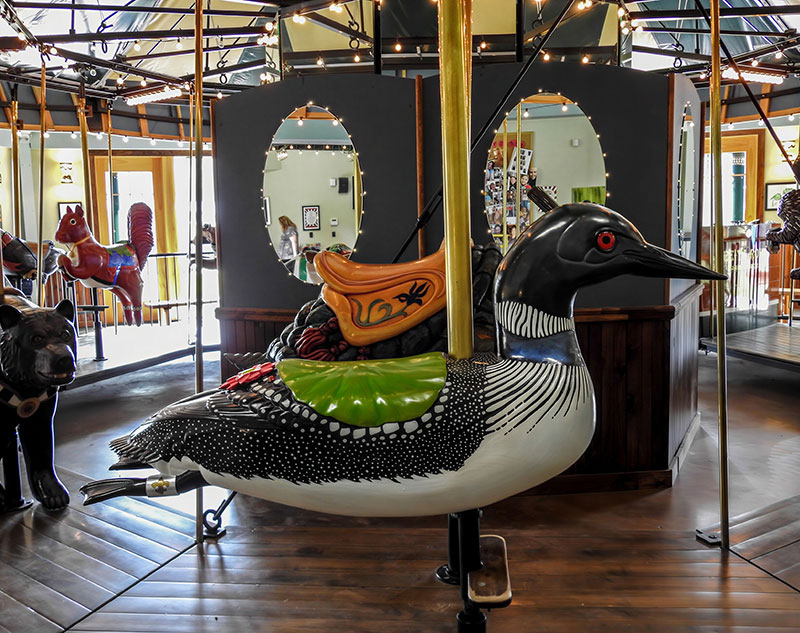
Lucy the Common Loon
Carver: Clifton “Jack” Barrette (Plattsburgh, NY) | Sponsor: Connie Weatherup
Lucy is one of the most popular animals on the carousel. Visitors always want pictures with Lucy, locals already have pictures with Lucy, and she makes for the classic Adirondack vacation photo. The loon can stay underwater for up to five minutes, its signature red eyes helping it locate prey while submerged.
Loons are large water birds with long bodies and short necks, and their feet are set far back under their tails. This makes them excellent swimmers but is also why loons can’t walk on land like ducks do. Their streamlined bodies help them swim fast, and their heavy bodies and solid bones make them less buoyant, so they can submerge quickly. Loons nest very near the shore so they can slide down the bank into the water, and they are remarkably agile underwater – steering with their feet, they can turn 180 degrees in a fraction of a second. Loons can only take off from water, and because they are heavy birds, they need a long runway of water to get airborne. Babies are called loonlets and can swim almost immediately after birth; you’ll see them riding on their parents’ backs to rest and to avoid predators.
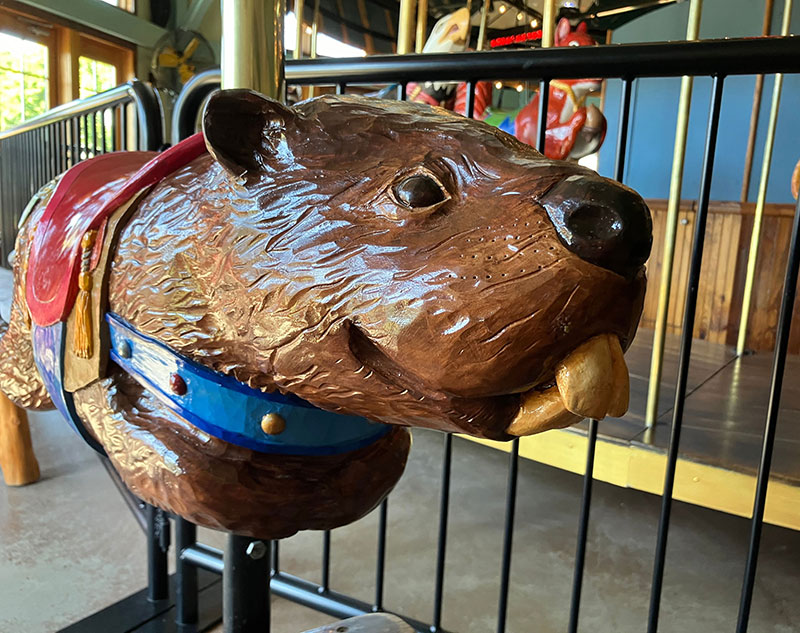
Chuck the Beaver
Carver: Carl Borst (Rotterdam, NY) | Sponsor: Anonymous
Chuck has one of the most beautiful faces on the carousel. As you wander around the building, you’ll notice a few carvings that aren’t riding the carousel on the day of your visit – an animal might be taken off as part of a regular rotation, to use in a display, or because a paint touch-up will take longer than one night. The carousel is open year-round, so we get plenty of kids climbing through snowbanks to get here. That’s okay. This is Saranac Lake. Just stomp your boots off as best you can and let’s ride!
The beaver is a very large rodent, powerfully built so it can carry heavy loads over long distances. With webbed feet, beavers are excellent swimmers. You may see a beaver slapping its flat tail on the water – that’s a warning sign. Beavers live near lakes and build lodges for shelter, then build dams to form ponds around those shelters. Their teeth never stop growing and contain iron for easy chewing.
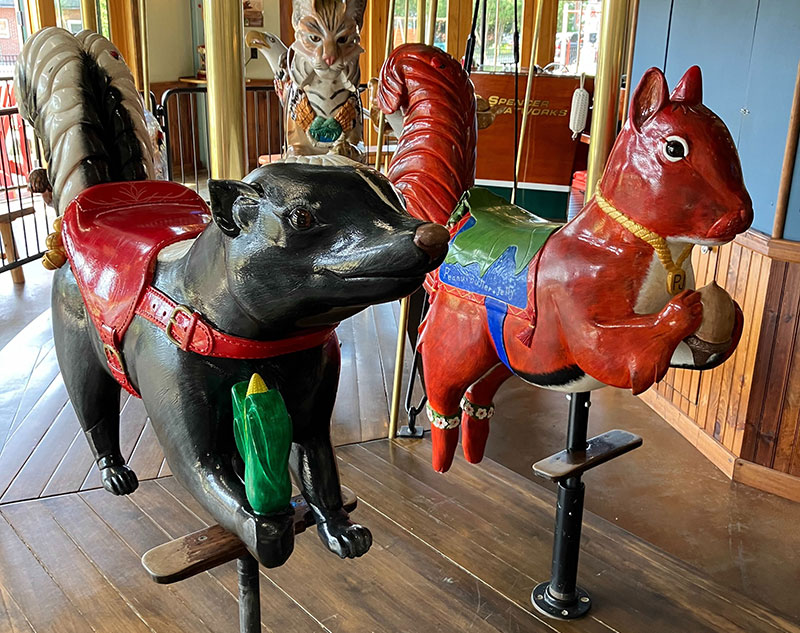
Spencer the Striped Skunk and Red Storm the Red Squirrel
Carver: Thomas Holzinger (Roanoke, Indiana) | Sponsor: Joan & Bill Grabe
Spencer is the happiest, luckiest skunk you’ll ever see! He gets all the corn he can eat, and every day kids come in and say “Hi Spencer!”
The common striped skunk is a protected species; it is illegal in all states to domesticate these little guys, as they are a common carrier of rabies. Skunks have excellent hearing and a fine sense of smell, and they eat berries, insects, and some small animals like mice – and if a skunk finds a broccoli field, he’ll be very happy, because it’s a favorite! Skunks are hesitant to use their spray. When threatened, they first try to escape, then hiss and stomp their feet; only when all else fails do they crunch up into a U shape and spray.
Red Storm the Red Squirrel
Carver: Thomas Holzinger (Roanoke, Indiana) | Sponsor: The Graduating Class of Saranac Lake High School, 1961
As the carvings arrived in Saranac Lake, local schoolchildren got a chance to look them over carefully and give each animal its official name. When the painter looked at this red squirrel, they saw “Peanut Butter and Jelly” – a very nice name. But when the school kids saw it, they saw “Red Storm”! The Saranac Lake Central School District’s teams are known as the Red Storm, and this is the only animal lucky enough to have two names.
Red squirrels are classified as rodents. They offer the same headaches to homeowners that mice and rats do – but they’re much cuter while they’re doing it! Rodents are intelligent, and the squirrel rates at the top of the list: they can swim, hang upside down, and run on wires. Red squirrels have a host of enemies – the fox, dogs, cats, hawks, and owls – and they don’t hibernate. They lose up to 25% of their buried winter food stores, so they have a tough life. Be kind to them!
Moonlight the Bobcat
Carver: Bob Eck (Ft. Lauderdale, Florida) | Sponsor: The Students of Paul Smith’s College
Bob Eck, the carver who created Moonlight, said: “The bobcat is a very special carving for me. If just one child enjoys my creative effort, it will have been worth it. I will feel honored.” Bob, if you only knew! Moonlight is always a favorite – we can’t even count the number of kids who have hugged her around the neck.
The bobcat is the smallest cat of the lynx family. Adults are usually 28 to 48 inches long and weigh between 15 and 35 pounds, with males larger than females (by comparison, a healthy house cat is usually around 10 pounds). Bobcats eat small prey like rodents and rabbits, and in winter a bobcat will also take a small deer if the opportunity presents itself. They make many sounds – hissing, snarling, spitting, and meowing. A female bobcat is called a queen and males are called toms; they are usually tan with black markings, turning reddish-tan in the warmer seasons. In the Adirondack environment, bobcats are generally nocturnal and smaller than in more stable climates – here, males average 21 pounds and females 14. Their range is vast: in the Catskill Mountains a male’s range covers about 14 square miles, but in the Adirondacks a single male will range over 136 square miles.
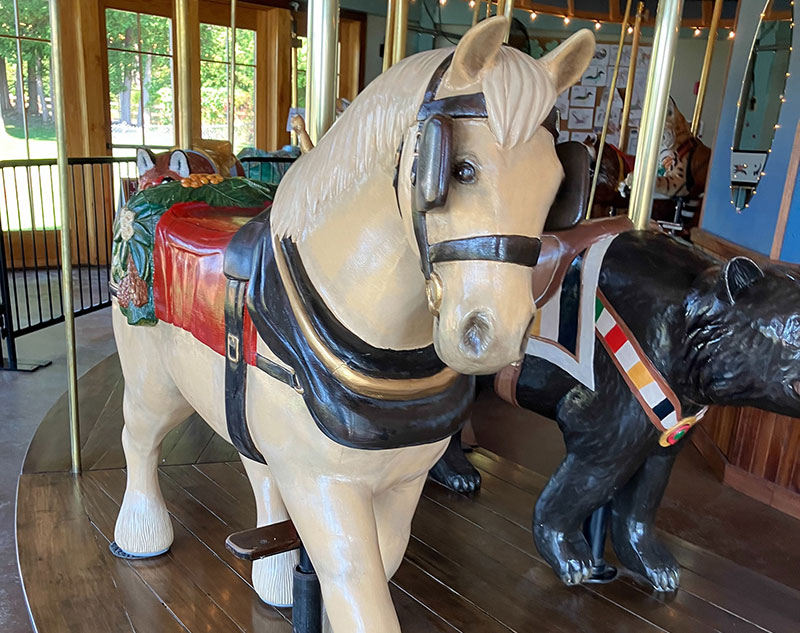
Thunder the American Cream Draft Horse
Carver: Lyde Buchtenkirch-Biscardi (Hyde Park, NY) | Sponsor: The Backer Family
Thunder is an American Cream Draft Horse, a breed developed in Iowa in the early 1900s. In logging days, draft horses did much of the hard work in the Adirondacks – and they still work here. When carousel aficionados visit, it is most often Thunder who catches and keeps their eye. It is unusual to find a draft horse on a carousel, and rarer still that it be an American Cream – but it’s his face that does the trick. Most carousel horses wear an expression often described as “pained.” Not Thunder. Thunder has the best draft-horse job in the world!
In carousel terminology, both Thunder and Paws are “Standers” – and Bubbles is a Stander too. Standers go around but do not go up and down. Animals that do go up and down are called “Jumpers,” and stationary seats such as a bench (or a boat) are called “Chariots.”
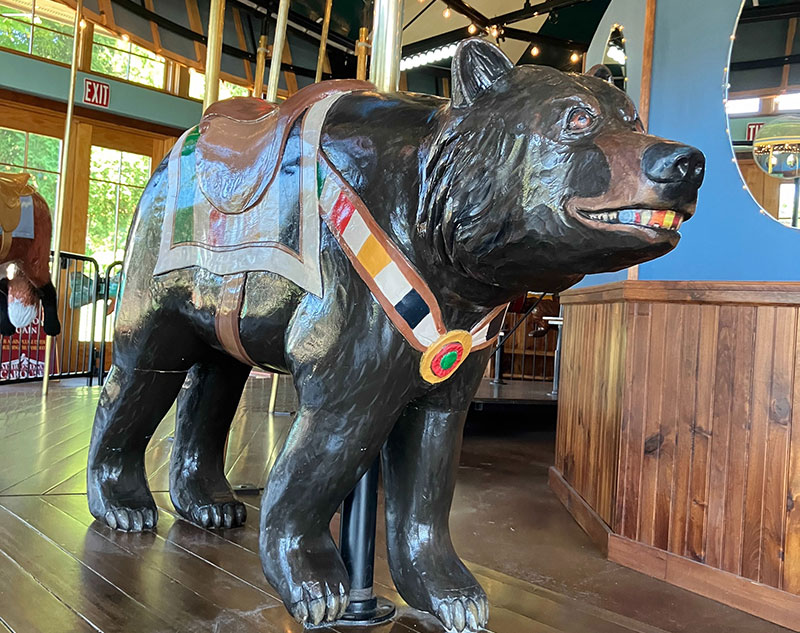
Paws the American Black Bear
Carvers: Carl Borst and Andy Manchester (Rotterdam, NY / Saranac Lake, NY) | Sponsor: Andrea and Tim Collins
Paws wears the colors of the Hudson Bay blanket. European fur traders like the Hudson’s Bay Company would exchange blankets for beaver pelts, and Native Americans and European settlers would often use them to make all sorts of capes, cloaks, and greatcoats.
Male black bears in the Adirondacks, standing on their hind legs, can be five to seven feet tall and weigh up to 600 pounds; females are much smaller. They can sprint as fast as a human, climb trees, and are strong swimmers. Population estimates show that between 3,000 and 5,000 black bears make their home in the Adirondacks.
See-Ya-Round the Chris Craft Boat (Chariot)
Builders: Michael Martin & Jay Annis (Saranac Lake, NY) | Sponsor: Anonymous
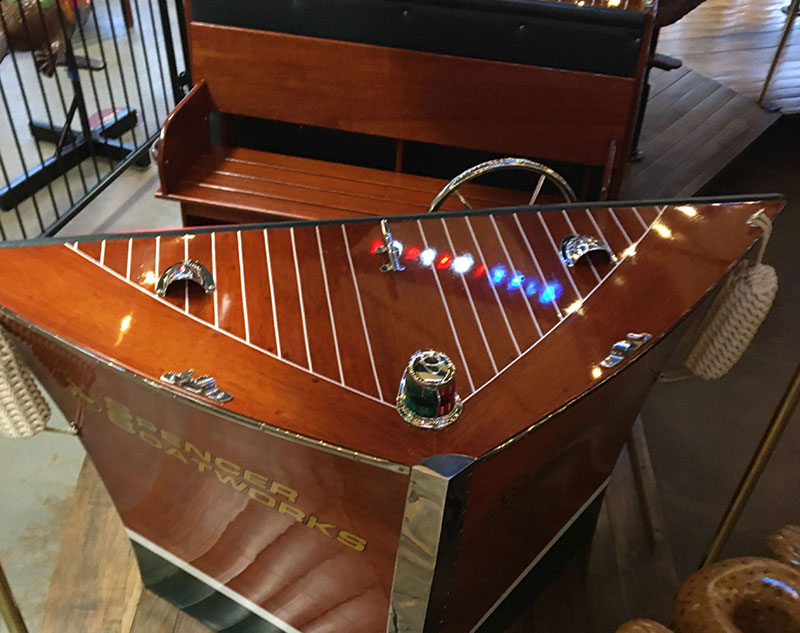
See-Ya-Round is an impeccably built model of a 1930s-era Chris Craft. Its fit and finish are as good as anything you’ll see out on the water – the local folks who built it are not your average woodworkers, and there is a plaque on the boat’s dashboard where you can read their names. On a carousel, any bench-type seat is called a “Chariot,” whether it’s a plain bench, a sleigh, a sea shell, or a boat.
See-Ya-Round, our Chariot, was built to be fully accessible to people with disabilities. The bench is easily removed to allow a wheelchair to be secured for a safe ride. Without this, some of our local children wouldn’t be able to ride – and neither would some of our senior citizens. You can sit back and watch if you want to, but this carousel was built for everyone. If you want to ride, we’ll make it happen. Over the years, thousands of kids have climbed in and out of this boat – sandals, crocs, bare feet, sneakers, snow boots, we see it all – and even so, See-Ya-Round’s finish is as good as it was when she was new.
Don’t Forget the Ladybug Hunt!
As you explore the carousel, you’ll notice ladybugs everywhere. Why? The nine-spotted ladybug is the New York State insect; the ladybugs create a “matched set” out of our wonderfully unmatched animals; and – the real reason – because nothing is more fun than a ladybug hunt! Every day you’ll hear children moving from animal to animal calling “Ladybug! Ladybug! Ladybug!” If you’re hunting, Flames the Fox will be your biggest challenge, and Bubbles the Heron hides the biggest ladybug of all in plain sight. Happy hunting!
Explore The Adirondack Carousel
The Adirondack Carousel in Saranac Lake is a community-built, year-round attraction featuring hand-carved figures inspired by Adirondack wildlife and culture. Created by volunteers and artists, it celebrates creativity, inclusivity, and the enduring spirit of the Adirondacks.
A Whimsical Ride in the Heart of the Adirondacks
The Adirondack Carousel in Saranac Lake brings classic charm to life with hand-carved animals inspired by local wildlife. It’s a joyful stop for families and visitors of all ages exploring the village.
Where Adirondack Wildlife Takes a Spin
Instead of traditional horses, the carousel features bears, loons, deer, and other regional favorites. Each ride celebrates the natural beauty and character of the Adirondack Mountains.
A Community Treasure in Downtown Saranac Lake
Built through local craftsmanship and volunteer support, the Adirondack Carousel reflects the town’s innovative and creative spirit. It stands as a symbol of pride and collaboration in the community.
Hand-Carved Art You Can Ride
Every carousel animal is uniquely carved and painted, making each one a small work of art. The attention to detail turns a simple ride into a memorable experience.
More Than a Carousel, It’s an Adirondack Story
The carousel blends storytelling, craftsmanship, and regional identity into one delightful attraction. Riding it feels like stepping into a moving tribute to Adirondack life.
A Year-Round Attraction with Small-Town Charm
Open in every season, the Adirondack Carousel offers a cozy and nostalgic activity no matter the weather. Rain or shine, please come visit with us!